

Tongue and groove for SPC wall panels is a flat profile that lets two wall panels connect while staying almost level with the wall. Some manufacturers may call it a Flat Click or T&G system.
This matters in real installation. A floor plank can often be lifted, angled, and rotated into position. A wall panel is vertical, often close to corners, ceiling trims, shower fittings, or kitchen cabinets. The installer usually needs a flatter horizontal movement.
Flat Click vs. Angle-Angle vs. Push-down Click
The easiest way to compare these systems is to look at the installation movement. The names may sound similar, but they describe different actions.
| System | How it Connects | Typical Use | Main Advantage |
|---|---|---|---|
| Flat tongue-and-groove profile | The tongue slides into the groove while the panel stays nearly flat. | SPC wall panels, bathroom panels, backsplash panels. | Easier near corners, ceilings, trims, and fixed walls. |
| Angle-Angle Click | One panel enters at an angle, then rotates down to lock. | SPC flooring, laminate, LVT, rigid floor panels. | Strong engagement and familiar floor installation. |
| Push-down Click | One side is positioned first, then pressed down or inward to lock. | SPC chevron flooring, laminate parquet flooring | Fast when the profile and site conditions fit. |
The key point: Flat Click supports a flatter joining movement, which can make wall installation easier in tight spaces.
Why Flat Click Fits SPC Wall Panels
SPC wall panels are often used in bathrooms, shower walls, kitchens, hotel rooms, retail interiors, and fast renovation projects. In these areas, the installer often works around fixed edges and limited space. A profile that needs a large lifting angle can slow the job down.
A flat tongue-and-groove profile lets the installer cut the panel, prepare the wall, apply adhesive or fixing material where required, place the panel, and close the joint with controlled alignment. This helps keep the visible seam cleaner.
The profile is only one part of the result. Good installation still depends on a flat, clean, dry, and stable wall.
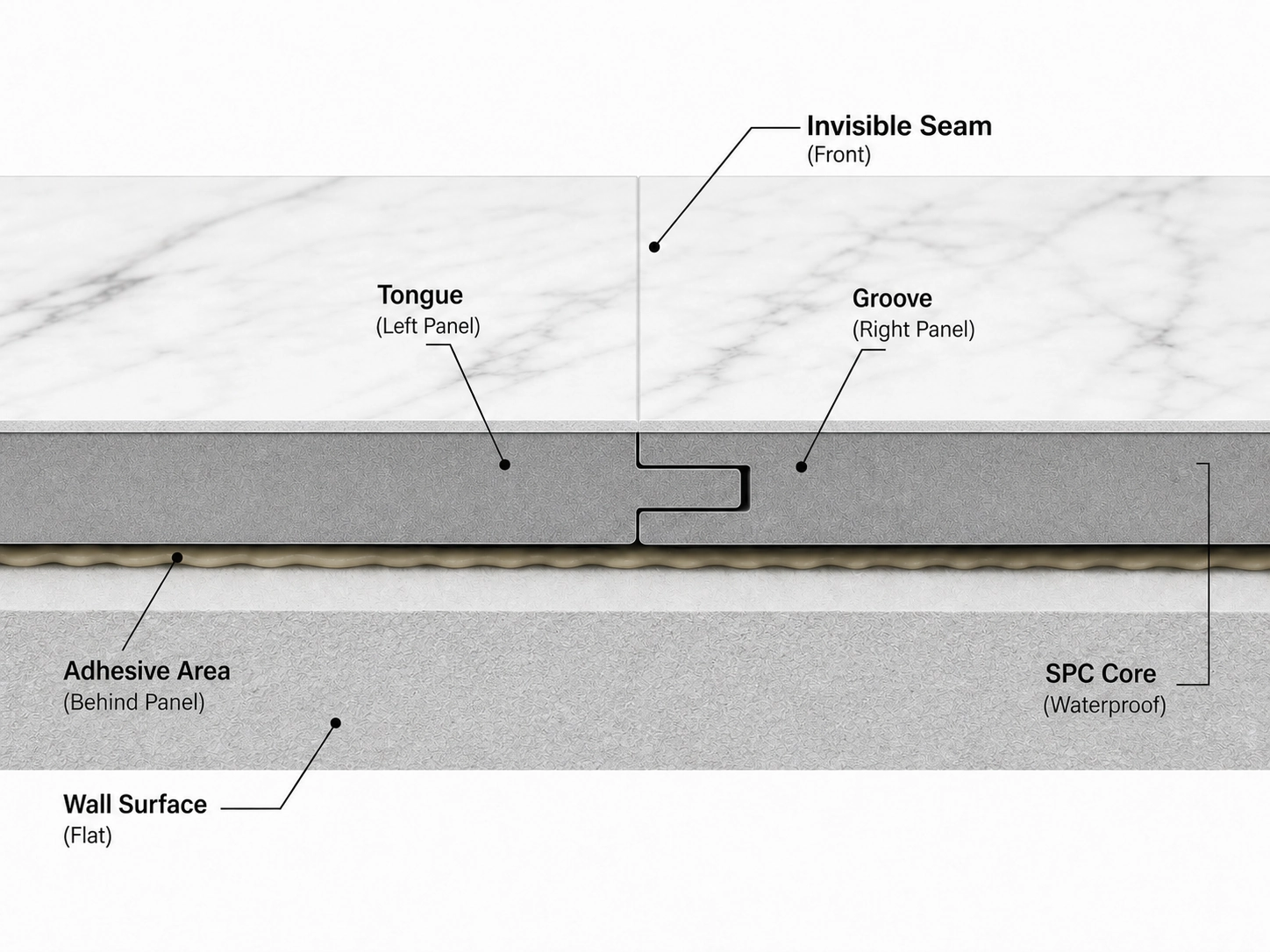
For more context, see HRFLOOR’s SPC wall panels and SPC wall panel structure.
How It Differs From Angle-Angle Click
Angle-Angle Click is mainly known from flooring. The installer places one plank edge into the previous plank at an angle, then rotates it down until the mechanical joint engages. This works well on floors because the plank has room to move.
On a wall, the same movement can be inconvenient. A large panel may already have adhesive on the back, or it may be close to a corner, ceiling line, or door frame.
That does not make Angle-Angle Click poor. It simply means the movement usually fits floors better than large vertical SPC wall panels.
How It Differs From Push-down Click
Push-down Click is usually designed for fast installation. One side is positioned first, and another side locks when the panel is pressed down or folded into place. Providers such as Unilin and Välinge show that drop, fold-down, and push-down profiles vary by product design and exact profile.
For flooring, this can be efficient because downward pressure follows the natural installation direction. On a wall, the installer may need to press inward while keeping the panel level. With large panels, that can feel less natural than a flatter side-to-side joint.
Why Tongue and Groove Fits SPC Wall Panels
SPC wall panels are often used in bathrooms, shower walls, kitchens, hotel rooms, retail interiors, and fast renovation projects. In these areas, the installer often works around fixed edges and limited space. A profile that needs a large lifting angle can slow the job down.
A flat tongue-and-groove profile lets the installer cut the panel, prepare the wall, apply adhesive or fixing material where required, place the panel, and close the joint with controlled alignment. This helps keep the visible seam cleaner.
The profile is only one part of the result. Good installation still depends on a flat, clean, dry, and stable wall.
FAQ
Tongue and Groove (T&G) is usually more practical for SPC wall panels because the panel can stay closer to the wall during installation. Angle-Angle Click can work well for flooring, but large vertical panels often do not have enough space for lifting and rotation.
The wall should be flat, clean, dry, and stable. If the wall is wavy, dusty, damp, or loose, the joint may not close neatly and the panel may not stay secure over time.
They can be suitable for bathroom and shower wall projects when the panel specification, wall preparation, sealing method, trims, and installation guide are all appropriate for wet-area use. Buyers should confirm waterproofing details and test reports before bulk orders.
To pick up a draggable item, press the space bar. While dragging, use the arrow keys to move the item. Press space again to drop the item in its new position, or press escape to cancel.